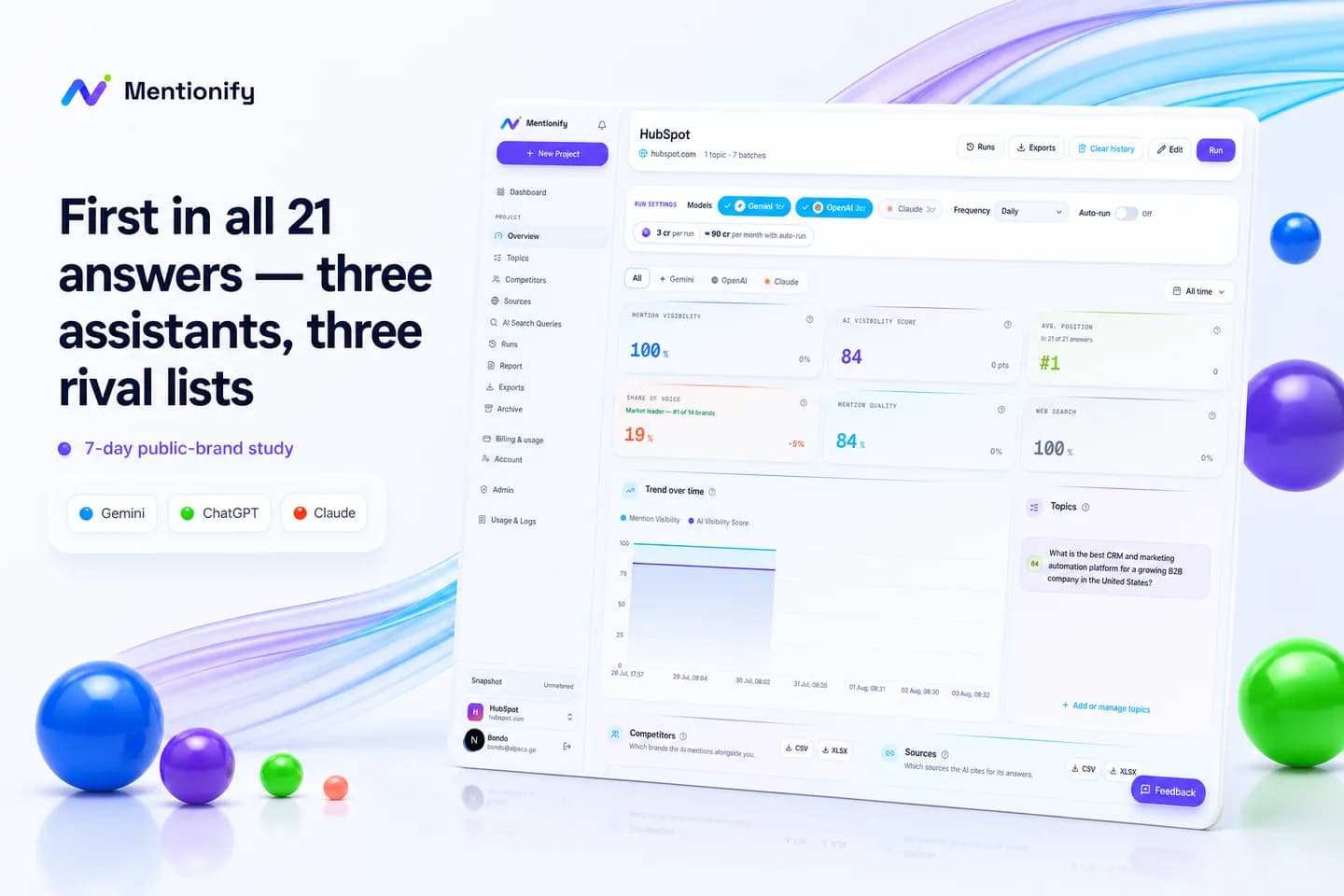
Ask a marketing team who their competitors are and you get a list. Ask three AI assistants the same question and you get three lists — and they barely overlap.
That is the finding from a week of daily checks on one B2B buying question. HubSpot came first in every single answer, so the part worth studying is not whether it won. It is who the assistants lined up behind it, because that changed completely depending on which one you asked. Thirteen rivals turned up across the week. Only four were named by all three assistants. Eight were named by exactly one.
What we ran
| Brand tracked | HubSpot (hubspot.com) |
| Question | "What is the best CRM and marketing automation platform for a growing B2B company in the United States?" |
| Assistants | Gemini, ChatGPT, Claude |
| Frequency | Once a day, seven days running |
| Window | 28 July – 3 August 2026 |
| Answers collected | 21 (7 runs × 3 assistants) |
| Answers where the assistant searched the web | 21 of 21 |
The question was put the way a buyer puts it: raw, with no system prompt, no instruction to search and no output limit, each model set to the tier a person on a free plan actually gets. One judge model then scored every answer, so the three columns below can be read against each other.
This is the third study in the set. The first two were a retail question and an ecommerce question, and neither produced this pattern — the ecommerce one had the same three names in every answer, week in, week out.
The headline numbers
| Metric | Value |
|---|---|
| Mention visibility | 100% (21 of 21 answers) |
| AI Visibility Score | 84 |
| Average position | #1.0, in 21 of 21 answers |
| Mention quality | 84 |
| Sentiment | 78 |
| Share of voice | 19% — first of 14 brands |
| Web search rate | 100% |
Position #1.0 across 21 answers means no assistant, on any day, put another platform ahead of HubSpot. ChatGPT's answer of 3 August starts with the words "Short answer" and finishes the sentence with HubSpot Customer Platform. Claude's, the same morning, opens by refusing the premise — "there's no single 'best' platform for every growing B2B company" — and then recommends HubSpot anyway.
Share of voice at 19% is the lowest of the three studies, and that is the first hint of what is going on: the answers are crowded. Fourteen brands were named in a week, on a single question.
Three assistants, three boards
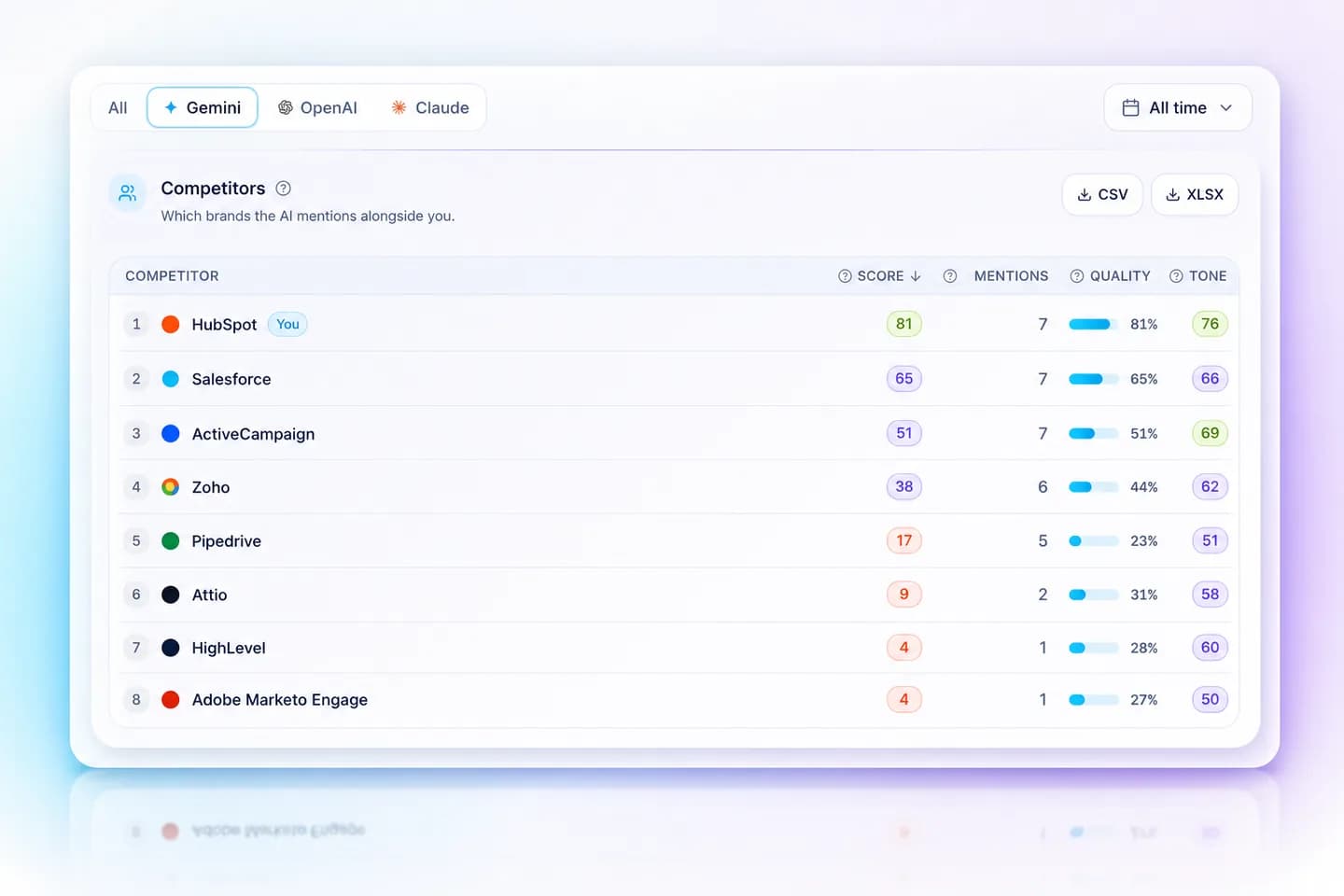
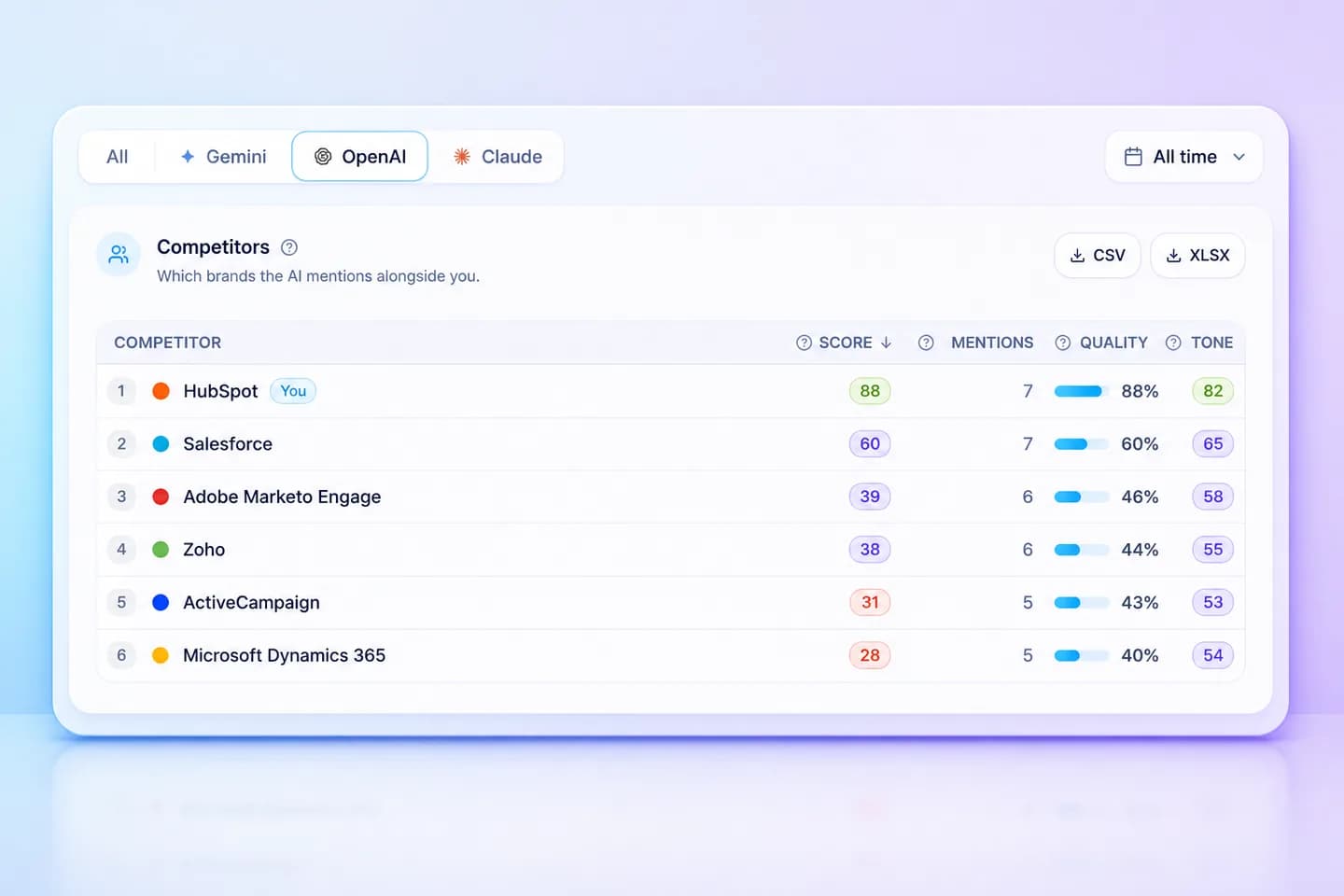
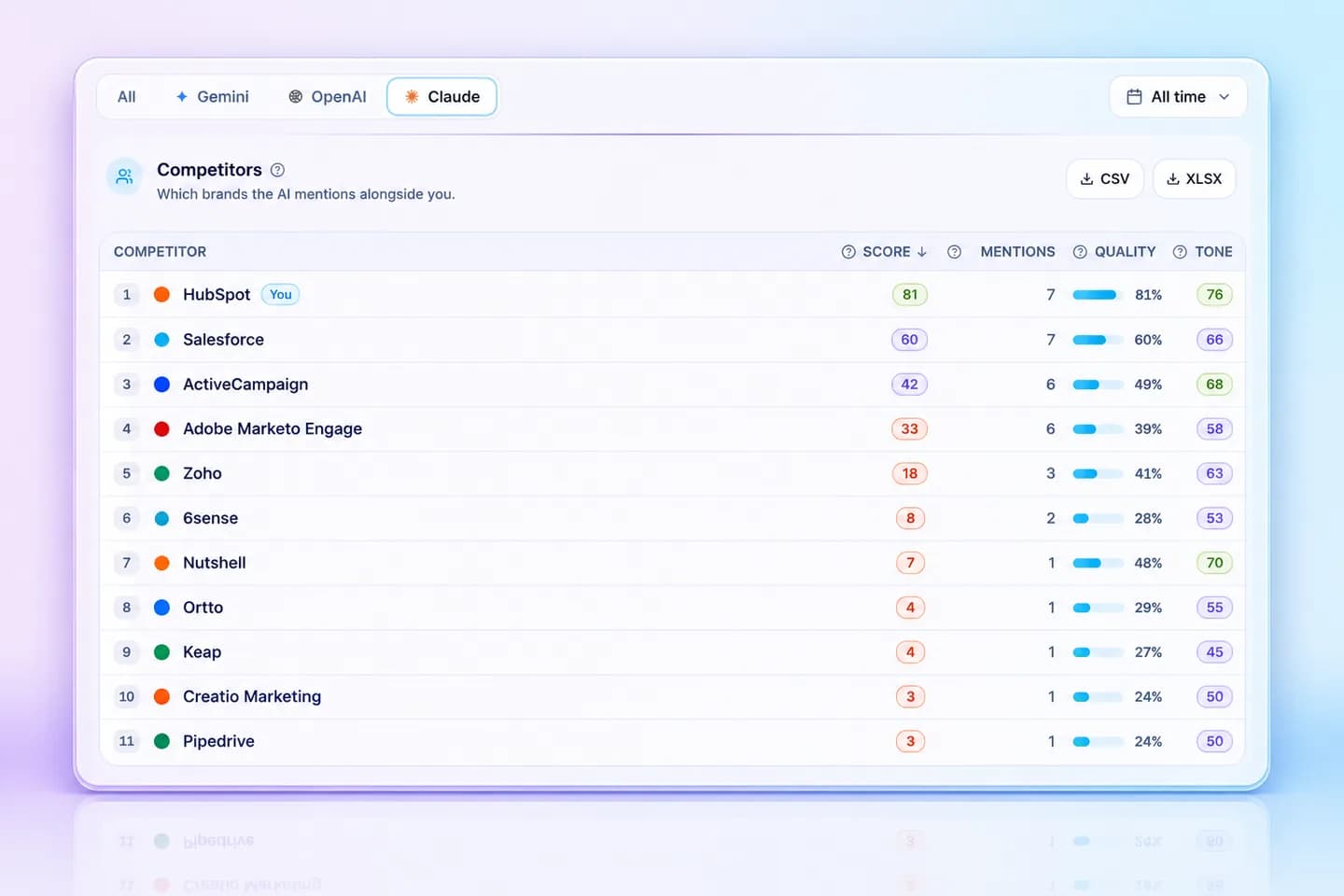
Here is the same leaderboard, for the same seven days, filtered to one assistant at a time.
Gemini named seven rivals.
ChatGPT named five.
Claude named ten.
Sorted out, the overlap looks like this:
| Named by | |
|---|---|
| Salesforce, ActiveCampaign, Zoho, Adobe Marketo Engage | all three |
| Pipedrive | Gemini and Claude |
| Attio, HighLevel | Gemini only |
| Microsoft Dynamics 365 | ChatGPT only |
| 6sense, Nutshell, Ortto, Keap, Creatio Marketing | Claude only |
Four names are the stable core. Everything below them is assistant-specific. A HubSpot competitor that gets itself into Claude's answers is invisible in ChatGPT's, and vice versa — and a HubSpot marketer reading only one assistant would come away with a materially wrong picture of the field.
One thing did not move: Salesforce was second in all three. The top of the answer is settled; the rest of it is not.
Why the boards differ
The searches each assistant runs before answering explain most of it. Across the week the three of them issued 61 searches, 55 of them distinct — the most of any study we have run — and they were not doing the same job.
ChatGPT researched like an analyst. Twenty-six searches, all distinct, and they read like a procurement shortlist: the Gartner Magic Quadrant for B2B marketing automation, a G2 grid, official Zoho pricing, and a site-scoped lookup of HubSpot's own pricing page. Its board is short because it kept checking the same few big names against primary sources.
Claude researched like a buyer asking around. Fifteen searches but only nine distinct — it repeated "best CRM and marketing automation platform for B2B company 2025" five times across the week and leaned on broad roundups. Roundups list long tails, which is exactly what its board looks like.
Gemini sat between them. Twenty distinct searches, no repetition, mixing category queries with product-news lookups — it went after HubSpot's Breeze AI and Salesforce's Agentforce by name.
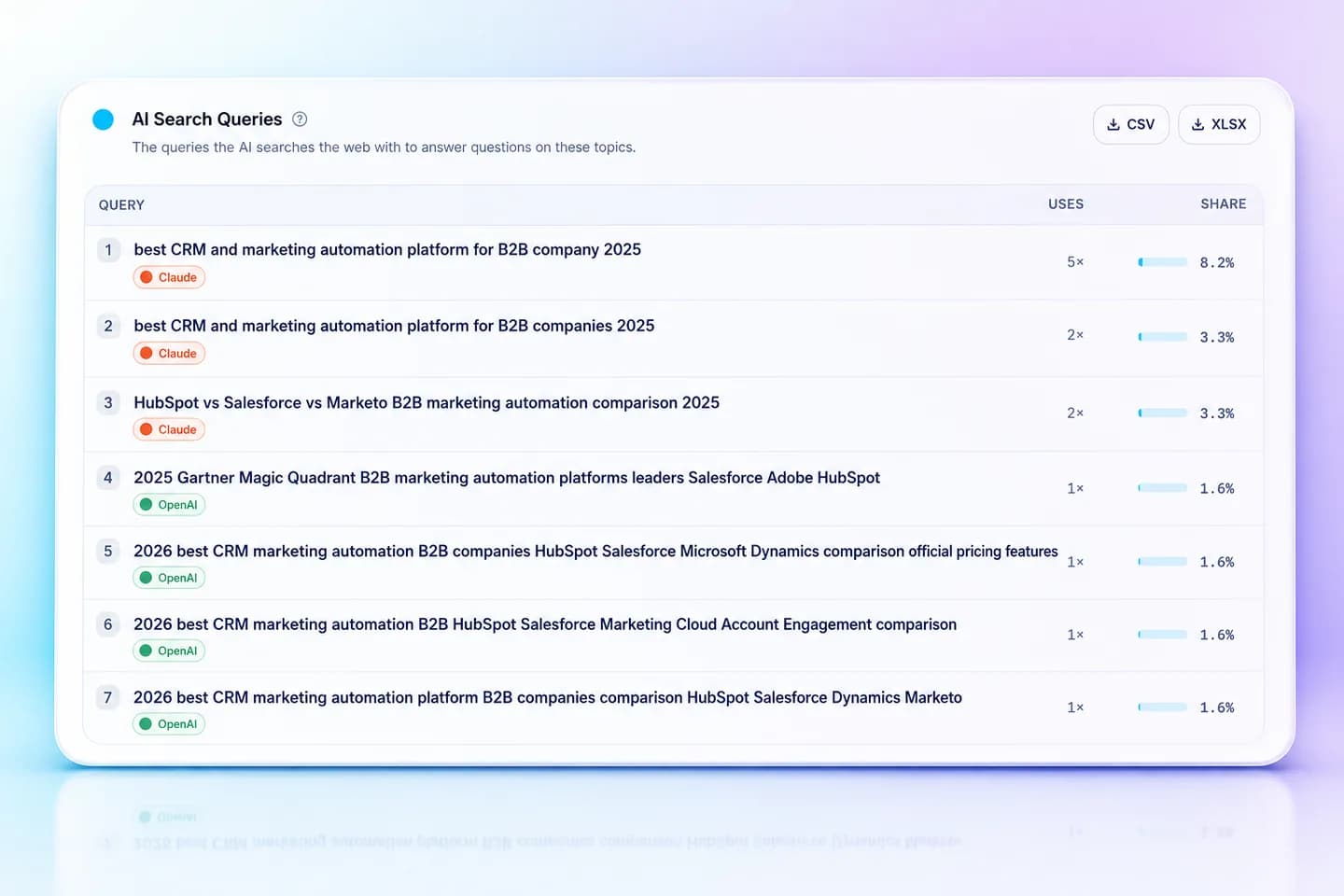
Different research, different sources, different runner-ups. Nothing mysterious about it once you can see the queries — but you cannot infer any of it from the answers alone, which is why the retrieval step is the part worth watching.
Whose pages the assistants read
227 citations across 100 distinct domains, the widest retrieval set of the three studies. The most read:
| Domain | Citations | Share |
|---|---|---|
| salesforce.com | 13 | 5.7% |
| 6sense.com | 12 | 5.3% |
| hubspot.com | 12 | 5.3% |
| gartner.com | 10 | 4.4% |
| ventureharbour.com | 9 | 4.0% |
| emailvendorselection.com | 7 | 3.1% |
| marketerhire.com | 6 | 2.6% |
| insiderone.com | 6 | 2.6% |
The two most-cited domains in HubSpot's category belong to competitors. Salesforce's own site was read more often than HubSpot's, and so, essentially, was 6sense's — a company that ended the week with a score of 3.
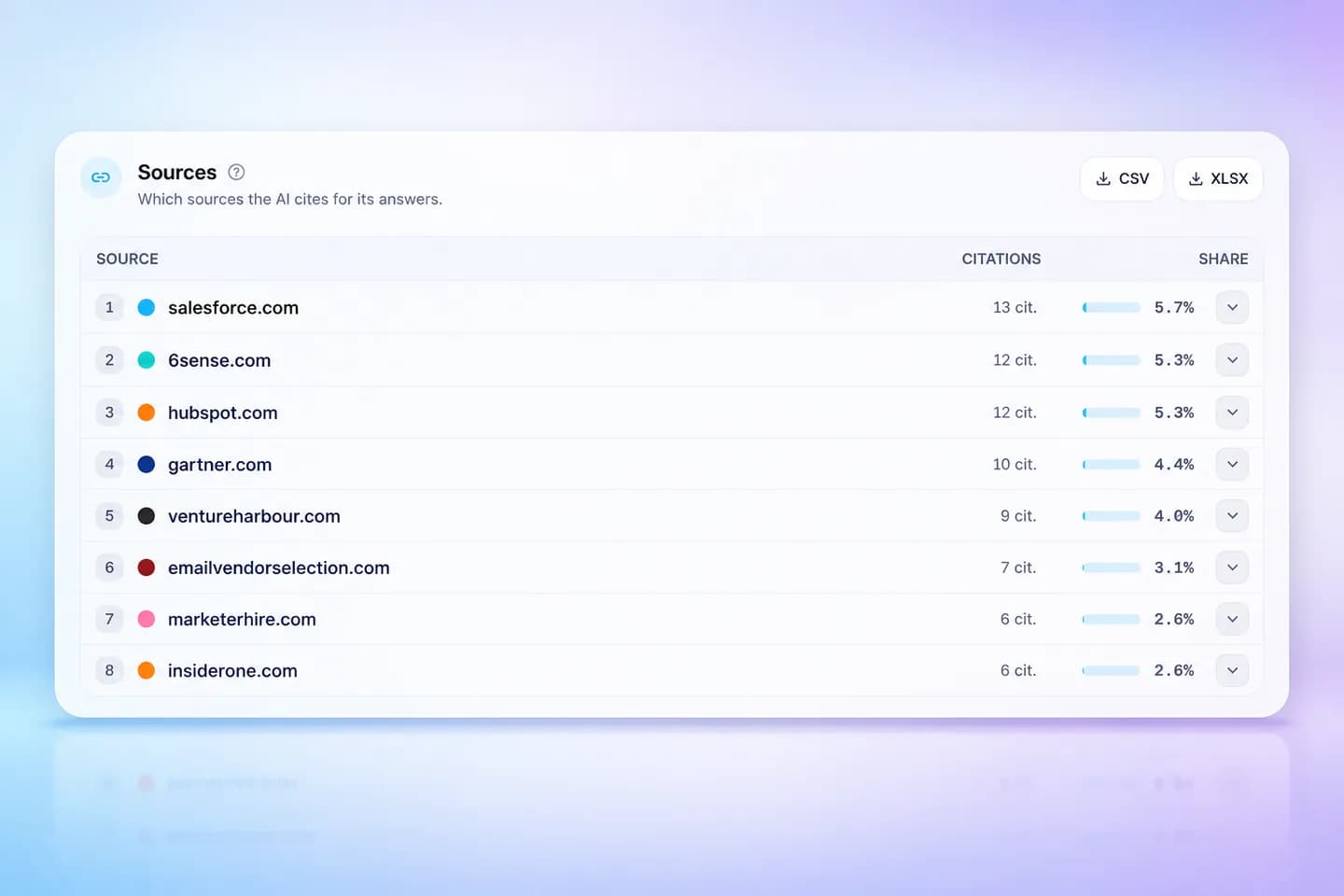
There is also an analyst in the mix, which the ecommerce study had none of: gartner.com is cited ten times, and four answers name Gartner in the text as a credibility marker. In B2B software the analyst grid is still doing work — inside AI answers, not just outside them. Below the top eight the tail is long and ordinary: 85 of the 100 domains were cited three times or fewer.
The board, and the company written five ways
Merged across all three assistants, fourteen brands:
| Brand | Score | Named in |
|---|---|---|
| HubSpot | 84 | 21 of 21 |
| Salesforce | 62 | 21 of 21 |
| ActiveCampaign | 41 | 18 of 21 |
| Zoho | 31 | 15 of 21 |
| Adobe Marketo Engage | 25 | 13 of 21 |
| Microsoft Dynamics 365 | 9 | 5 of 21 |
| Pipedrive | 7 | 6 of 21 |
| Attio · 6sense | 3 | 2 of 21 each |
| Nutshell | 2 | 1 of 21 |
| Ortto · HighLevel · Keap · Creatio Marketing | 1 | 1 of 21 each |
That table took work to produce, and the work is worth naming. The judge wrote nineteen different brand names across the week for thirteen actual companies. Adobe's marketing platform appeared as "Adobe", "Marketo", "Marketo Engage", "Adobe Marketo" and "Adobe Marketo Engage". Microsoft appeared three ways. Counted naively, Adobe is five rows too small to notice, instead of the single row at 25 that makes it the fifth-biggest presence in the category.
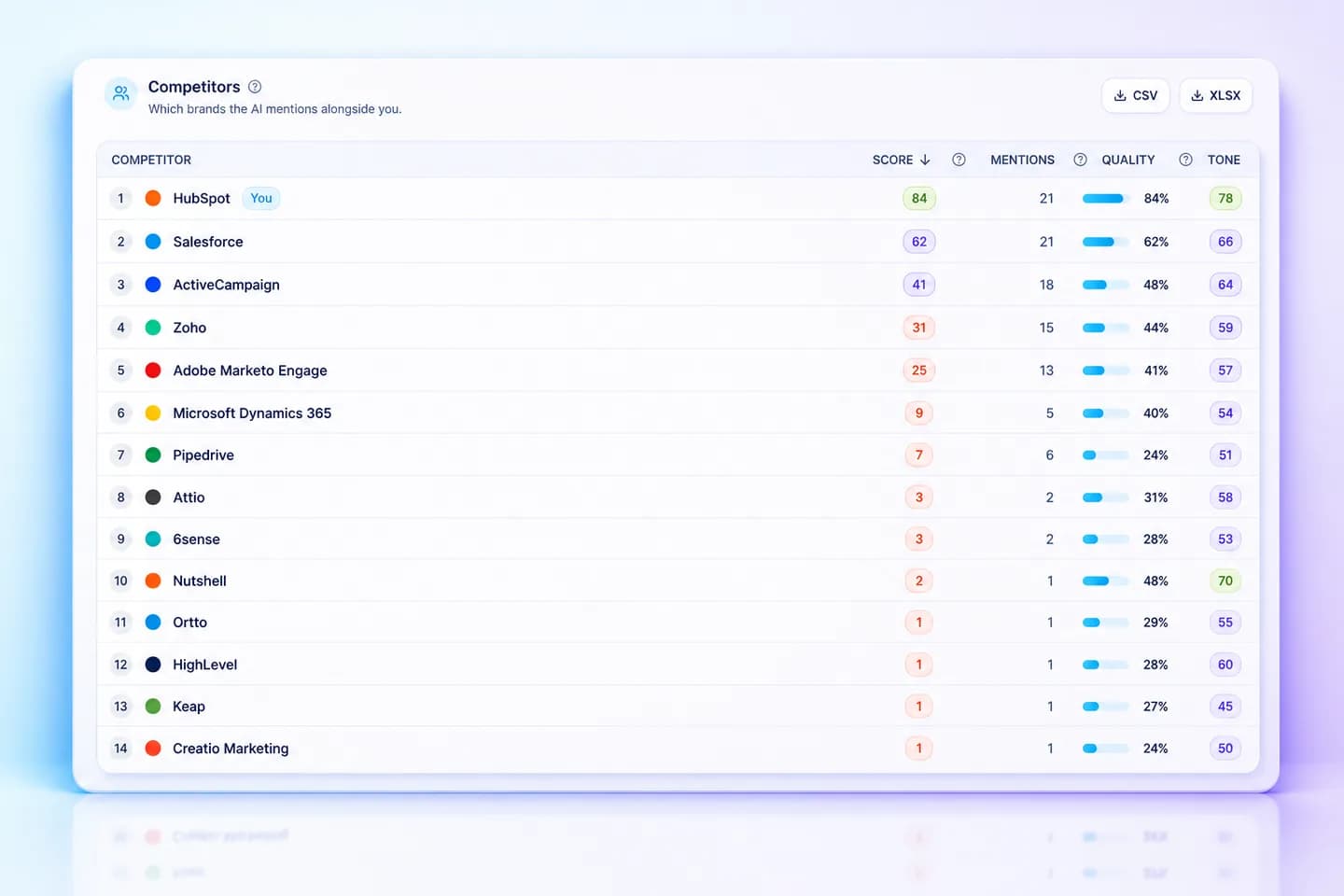
Each candidate name is checked against a live, reachable website that has to name the company before two rows are merged. It is unglamorous plumbing, and without it a leaderboard in a category with this much sub-branding is decoration.
Where the pressure actually is
Five axes, averaged over the 21 answers:
| Axis | Score |
|---|---|
| Placement (where in the answer it sits) | 96 |
| Prominence (how much of the answer is about it) | 96 |
| Framing (how favorably it is described) | 96 |
| Frequency (how often it recurs within the answer) | 73 |
| Coverage (share of the answer's real estate) | 59 |
Three axes are effectively maxed. Coverage at 59 — it never rose above 70 in any answer — is the same story the 19% share of voice tells: the assistants like HubSpot and put it first, then spend nearly half the reply on the other thirteen names.
Sentiment averaged 78 and ranged 65 to 85, and the reason for the low end is remarkably consistent. Twelve of the 21 answers carry a price-scaling caveat — onboarding fees, per-contact tiers, the $800-a-month Professional plan. Gemini went further and gave it a name, in its own words on 29 July:
The "HubSpot Tax": While starting tiers are affordable, pricing escalates steeply as your contact database grows.
Eight of the 21 answers file HubSpot's pricing as "premium" rather than "mid_range". That is not a sentiment problem to be managed; it is the one objection the retrieved pages keep supplying, and it is the most actionable thing in this dataset.
What to take from it
Your competitive set is a per-assistant fact. Salesforce is HubSpot's rival everywhere. Attio is its rival in Gemini and nowhere else. Any competitive brief built from one assistant is one-third of the picture — and on a retail question the same week, one assistant put the rival ahead of the brand outright.
Being read is not the same as being ranked. 6sense scored 3 and was cited 12 times. Its content is in the retrieval set that decides the category, even though the answers barely name it — and content in the retrieval set is how a brand starts being named at all. That is the cheaper half of the work of getting onto a shortlist.
Analyst coverage still pays, in a new place. Gartner was cited ten times and named in four answers. In B2B, the grid is now an input to the machine as well as to the buyer.
Sub-brands split you. If your product is sold under a parent name, a hub name and a legacy name, the assistants will use all three, and any measurement that does not merge them will understate you exactly the way it understated Adobe here.
What this ran on
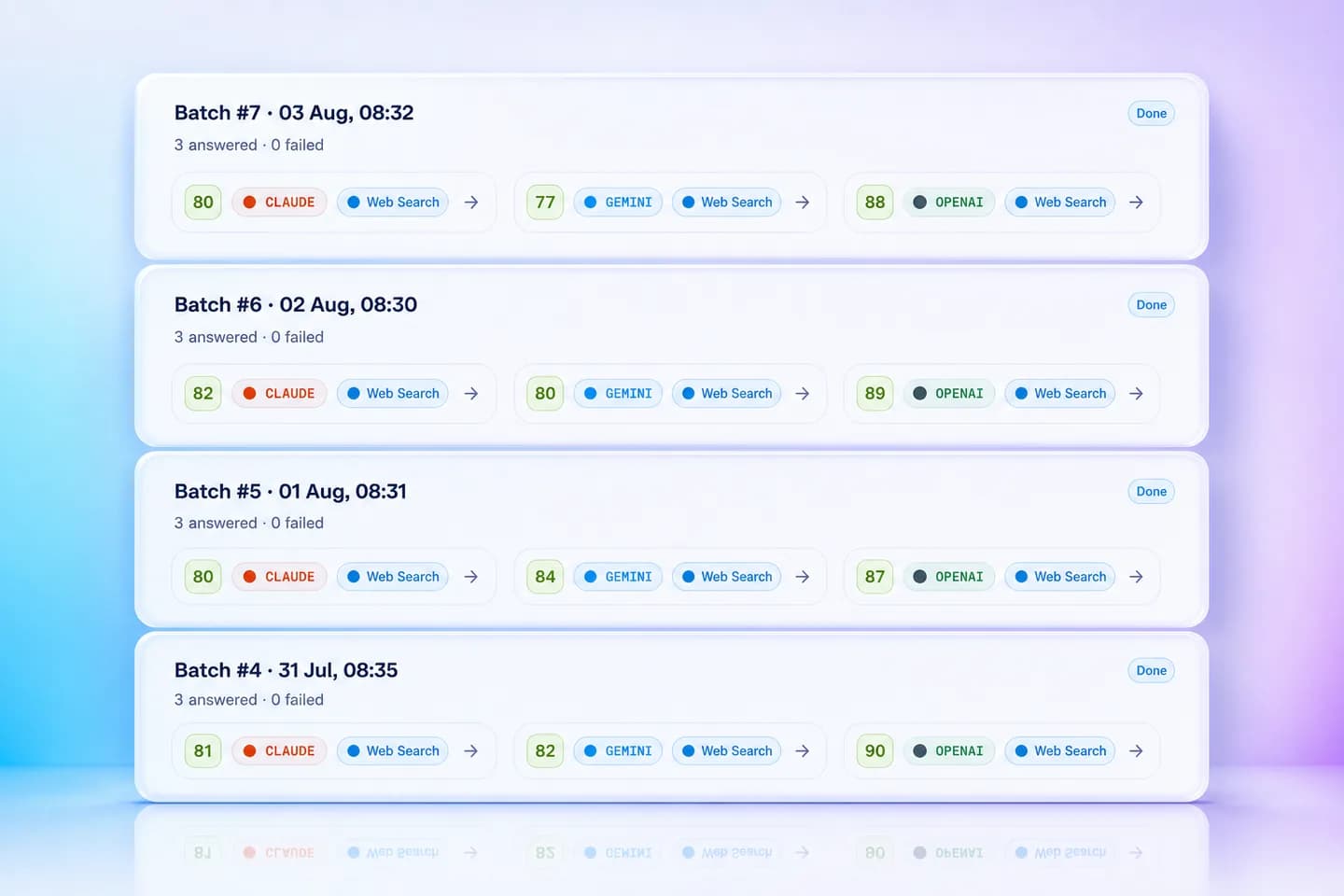
One project, one tracked question, seven days, nobody watching it. Each answer keeps its own scorecard, and the topic page is where a single question's whole history sits:
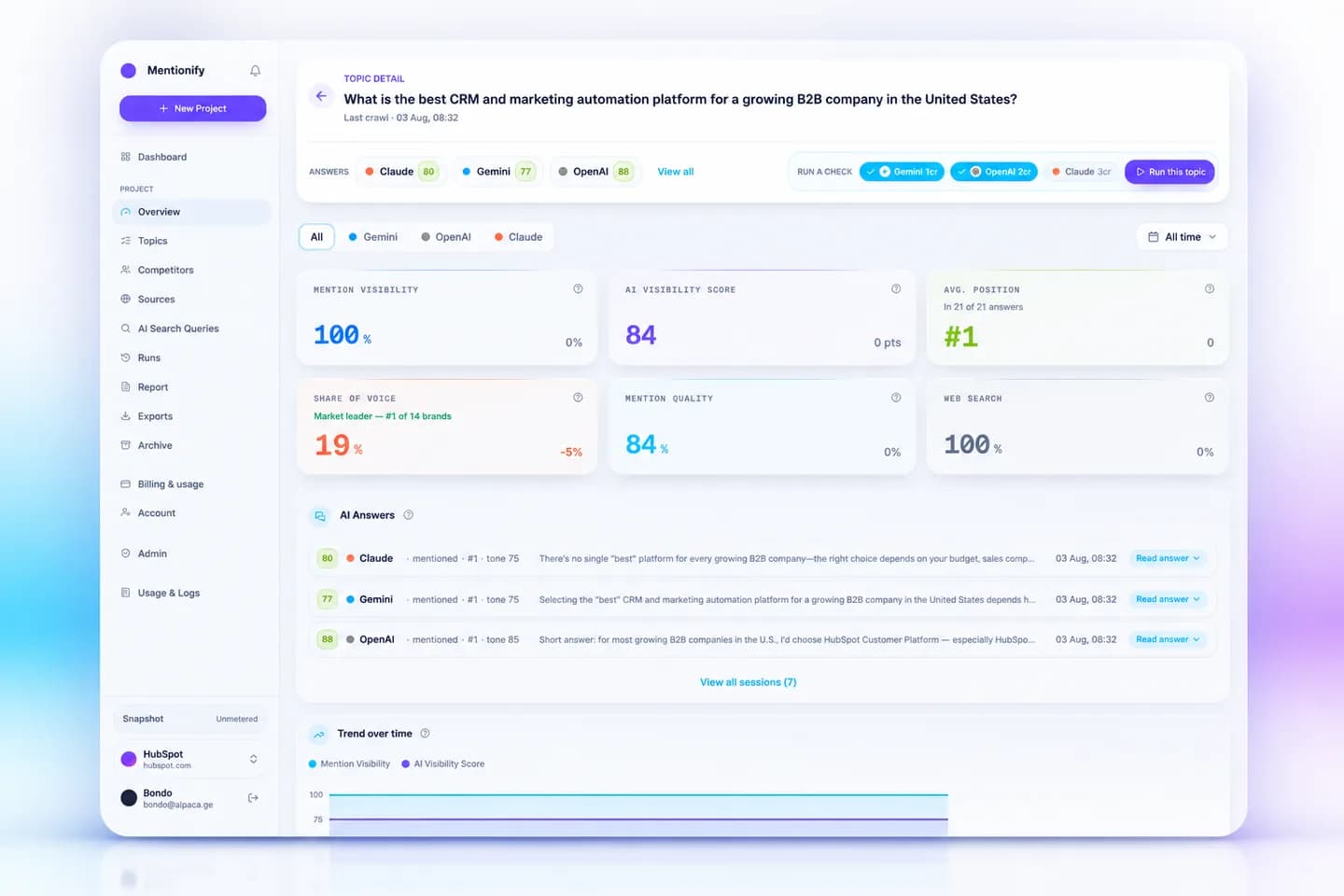
The surfaces this study's data lives on: topics with a per-topic score and detail page · models, each with its own tab and its own baseline — the three boards above are one click apart · daily runs, seven of them, each at a fixed credit price · the six headline metrics with period-over-period deltas · trend over time across a rolling window, a calendar month or an explicit range · competitors, scored on the brand's own scale with the alias resolution described above · sources, every domain with its exact URLs and share · AI search queries, attributed to the assistant that issued each · runs and archive, every settled run and raw answer kept · per-answer recommendations, where the pricing theme surfaced · and a printable report plus CSV/XLSX exports scoped to the same period and model as the screen.
If you want to see the same thing for your own category, one question against all three assistants is free. What a single check cannot give you is the comparison that made this study worth writing: three boards, side by side, from the same week.
FAQ
Isn't this just Claude being more verbose?
Partly, and that is the point rather than an objection. Claude produced longer answers with longer lists, ChatGPT produced short answers anchored on primary sources, and both are what a real buyer sees. The consequence for a smaller CRM vendor is concrete: it is far easier to enter Claude's answer than ChatGPT's, and the two require different work.
Does HubSpot winning every answer make the study boring?
It makes the headline boring. The interesting numbers were never the rank — they were the 19% share of voice, the eight rivals only one assistant knew about, and the twelve answers that mention pricing as a caveat. A brand that only tracks whether it is mentioned would have recorded a flat, perfect week and learned none of that.
How do you know two names are the same company?
Each proposed domain is fetched and the page has to actually name the company before two rows are merged; an unreachable host settles nothing and is retried next run. The full mechanics of the score itself are in how a single answer becomes a number.
Where are the other studies?
Amazon on a retail question and Shopify on an ecommerce one, both run the same week with the same method — both are here, and the retail one is the odd result of the three: an assistant that scored a competitor higher than the brand we were tracking.